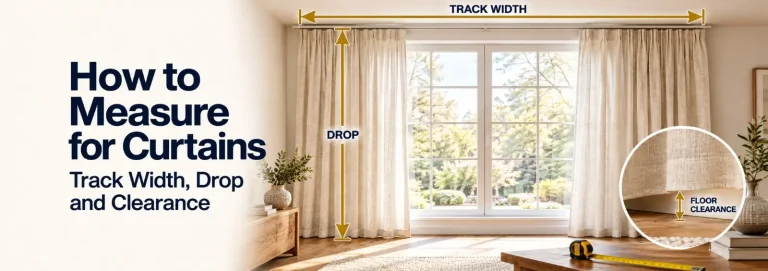
Sheer curtains let filtered daylight into the room. Blackout curtains are made to stop light from passing through the fabric. That one difference decides most of the choice. A sheer softens the light, gives some daytime screening and keeps the room bright, but it will not darken the room and gives little privacy once your lights are on at night. A blackout curtain can darken a room and hide it from view at any hour, but only while it is closed, and how dark the room gets also depends on how well the curtain covers the window edges.
So start by asking which job the window needs. Choose sheer for soft daylight, blackout for darkness and full privacy, or both when the same room needs each function at different times of day.
What Is the Difference Between Sheer and Blackout Curtains?
The difference lies in how much light each fabric lets through. A sheer has a light, open weave that transmits and diffuses daylight. A blackout curtain uses a densely woven face fabric, a light blocking coating or a separate blackout lining, so very little light passes through the material itself.
The comparison below uses the same criteria for both. It describes the two categories in general. A specific fabric still needs to be checked as a sample, because density, colour and lining vary from one product to another.
| Criterion | Sheer curtains | Blackout curtains |
|---|---|---|
| Main purpose | Filter and soften daylight while the curtain is closed | Block light and screen the room while the curtain is closed |
| Fabric construction | Lightweight, open or fine weave | Dense face fabric, a coated fabric or a blackout lining behind the face fabric |
| Room with curtain closed in daytime | Stays bright, with diffused light and less harsh glare | Becomes dark; any remaining light usually enters around the edges |
| Daytime privacy | Partial; details are blurred, especially when it is brighter outside than inside | Full view blocking while closed |
| Night privacy with interior lights on | Weak; silhouettes and the room can often be seen from outside | Full view blocking while closed |
| View outward | Softened view remains | No view while closed |
| What decides the actual result | Weave density, colour and the balance of light inside and outside | Fabric or lining construction plus coverage at the sides, top and centre |
The rows that matter most are the night privacy row and the last row. A sheer’s privacy changes with lighting conditions, and a blackout curtain’s darkness depends on fitting as well as fabric. Both points are explained below.
How Do Sheer and Blackout Curtains Affect Daytime and Night Privacy?
A sheer gives conditional privacy that mainly works in daytime. A closed blackout curtain blocks the view at any hour. The deciding factor for a sheer is not the fabric alone but which side of the window is brighter.
Privacy during the day
When it is brighter outside than inside, a sheer reflects and scatters much of the light falling on it. People outside see a pale screen and blurred shapes more than the room behind it, while you can still see out. How well this works depends on the weave: some sheers are close to transparent even in daylight, while denser sheers hide more detail. Distance and viewing angle also change what a neighbour or passer by can make out.
Privacy at night
At night the balance reverses. With interior lights on and darkness outside, the room becomes the brightest side of the glass. Light from inside passes through the sheer, and people outside can often see the room and the people in it, softened but not hidden. The brighter the room is compared with outside, the more is visible.
A closed blackout curtain does not depend on that balance. Its fabric is built to stop light passing through, so the room stays screened whether the lights are on or off. The trade off is that you lose daylight and your view while it is closed.
If a room is used in the evening with lights on and faces neighbouring windows or a street, a sheer on its own will not provide privacy at that time. You will need a curtain that can be closed with an opaque fabric.
Which Curtain Type Provides Better Room Darkening?
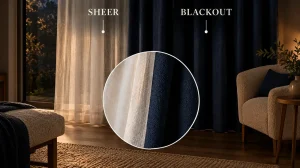
Blackout curtains are the only one of the two designed to darken a room. A sheer reduces glare but leaves the room light. Even with a blackout curtain, though, how dark the room becomes is a property of the whole installation, not only the fabric.
Light can reach the room through three routes:
- Through the fabric. Blackout performance depends on construction. Lining suppliers distinguish between single coated linings, which can still allow some light through, and multi layer blackout coatings, which are designed to stop light passing through the material. Lighter colours and lighter weaves without a blackout layer will let more light through.
- Around the sides. A curtain that ends level with the window frame leaves a gap where light spills past the edge. Manufacturers of light control products identify edge gaps as a main source of light in a room that is meant to be dark. Extending the curtain beyond the frame so it overlaps the wall reduces this.
- Over the top and through the centre. Light can escape above the track and where two curtain panels meet. The fitting position, the amount of overlap where the panels meet and anything covering the top of the track all affect this.
This is why a blackout label alone does not guarantee a completely dark room. A blackout fabric fitted inside a recess, with gaps at the sides and top, can leave visible bands of light. The same fabric fitted wider and higher than the opening, with enough overlap where the panels close, leaves fewer paths for light to get in. When you compare options, ask to see the fabric against a bright light and ask how the curtain will be positioned around the window, not only which fabric it is.
Which Curtain Type Suits Each Room Requirement?
Choose by the requirement, not by the room’s name. Two bedrooms can need different things: one is used only at night, the other is used for daytime sleep. Use the table below to match what the room needs to the function that delivers it.
| What the room needs | Function that suits it | Why | What to check before choosing |
|---|---|---|---|
| Darkness for sleep, including after sunrise or during daytime rest | Blackout | Only blackout fabric is designed to stop light passing through | Fabric or lining construction, and coverage at the sides, top and centre |
| Bright, softened daylight during the day without an open view in | Sheer | Diffuses light and blurs the view from outside while the room is darker than outside | How transparent the sample is in daylight |
| Privacy in the evening with lights on | Blackout, or another opaque layer | A sheer reveals a lit room at night | Whether the closed curtain screens the full window |
| Screen glare in a home office or study while keeping daylight | Sheer first, with an opaque option if glare persists | Diffused light reduces harsh contrast without darkening the room | Where the screen faces relative to the window, and the sample’s density |
| A dark room for projector or television viewing in daytime | Blackout | Daylight in the room washes out the picture | Edge coverage, since small gaps are noticeable in a dark room |
| Daylight by day and privacy or darkness at night in the same room | Both, as separate layers | Each fabric does one job well | Space for two independently operated curtains |
Two practical points come out of this table. First, if one requirement on your list is darkness or evening privacy, a sheer cannot be the only curtain on that window. Second, if the room also needs daylight while someone is using it, a blackout curtain on its own means choosing between a dark room and an open window. That situation is where combining the two makes sense.
If you are leaning towards one type, compare the available sheer curtains or blackout curtains and ask to see samples against the light conditions of your own room.
When Should You Combine Sheer and Blackout Curtains?
Combine them when one window needs both functions at different times: filtered daylight and some screening during the day, then darkness or full privacy in the evening. The sheer stays closed in daytime and the blackout curtain closes at night. Each layer can be used without the other.
This only works if each curtain can open and close independently, so the window needs enough space for two layers, two sets of hardware and the fabric gathered at the sides when open. Those fitting details depend on the specific window and hardware, so confirm them during the measurement visit rather than assuming any window can take two layers.
Making the Choice
Sheer curtains suit rooms where daylight matters more than darkness and where daytime screening is enough. Blackout curtains suit rooms that must become dark or stay private with the lights on, as long as the fabric and the fitting both stop light. When a room needs both, two layers let you use each function at the right time.
To move from the comparison to a specification, contact Jabal Al Riad with a photo of the window, what the room is used for and when it needs light, privacy or darkness. Ask which fabrics suit those requirements and how the curtain will be positioned to cover the window.