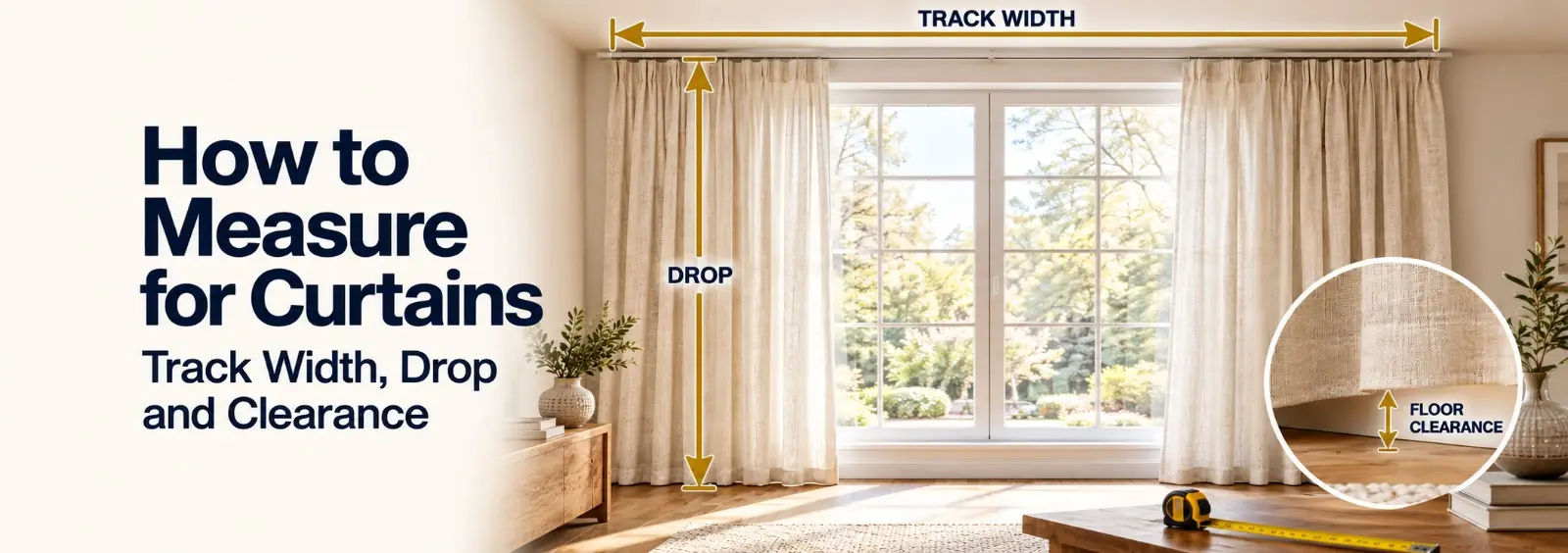
To measure for curtains, record four things: the span of the track or pole, the drop from the point where the curtain will hang to where you want the hem to finish, anything near the window that the curtain must clear, and the wall space available for the curtain to gather when it is open. Use one unit throughout, preferably centimetres or millimetres, and photograph the window with the tape in view. These are preliminary measurements for an estimate. Made to measure curtains are normally manufactured from dimensions checked on site against the actual heading and hardware, so your readings start the quotation rather than fix the final size.
What Should You Measure Before Requesting a Curtain Quote?
Measure the window opening, the hardware position and the space around the window. A supplier needs all three because the curtain size follows the hardware, not just the glass.
Use a steel tape measure, a pencil and a sheet with a simple sketch of the window. Take each reading in more than one place, because walls, ceilings and floors are rarely perfectly square or level, and write every reading down rather than only the one you think is right.
| Measurement | Where it starts and ends | Why the quote needs it |
| Window opening width | Inside edge to inside edge of the frame or recess | Shows the area the closed curtain must cover |
| Proposed track or pole span | End to end of the hardware, at the position you want it fitted | Determines how much curtain fabric and hardware is needed |
| Mounting position | Inside the recess, on the wall above the opening or on the ceiling | Changes both the width reference and the drop reference |
| Height of the mounting position | Distance from the top of the opening to the proposed track or pole, and from that point to the ceiling | Shows whether the hardware can sit higher or must fit a fixed space |
| Finished drop | From the hanging point of the hardware to where you want the hem to end | Sets the curtain length |
| Floor to ceiling height | At the window, in more than one place | Needed for ceiling fixed tracks and full height curtains |
| Wall space beside the opening | From each side of the opening to the nearest corner, cabinet or obstruction | Shows where the curtain can gather when open |
| Obstructions | Handles, door tracks, air conditioning units, switches, sockets, cornices or curtain boxes, with their position and projection | Shows what the curtain and hardware must clear |
If the existing track or pole will be replaced, the opening and wall measurements matter more than the old hardware, because the new hardware position is still open for discussion. You can review the curtain tracks and accessories available before deciding whether to keep, move or replace what is already fitted.
Where Is Curtain Width Measured: the Window or the Track?
Curtain width is planned from the track or pole span, not from the glass. The opening width and the hardware span are two different measurements, and a quote needs both.
Inside a recess
When the track fits inside a recess, the recess itself limits the span. Measure the recess from wall to wall at the top, where the track would be fixed, and at least one more height. Note the recess depth as well, because the track, the curtain folds and any window handle all have to fit within it.
Outside the opening
When the track or pole fits on the wall or ceiling outside the opening, its span usually extends beyond the window on each side. That extension lets the curtain gather beside the glass instead of over it and helps the closed curtain overlap the opening edges. How far it extends is a design decision that depends on the available wall space, the fabric and the heading, so record the space you have on each side and the span you would prefer, then ask the installer to confirm it.
For a pole, measure the length between the end brackets and note the decorative finials separately, since finials add length beyond the usable curtain span. For a track, measure end to end of the track itself.
Do not try to calculate the fabric width yourself. The amount of fabric gathered across the span depends on the heading style, so the supplier works it out from the hardware span and the selected heading.
Where Is the Curtain Drop Measured From and To?
Measure the drop from the point where the curtain will hang on the hardware down to where you want the hem to finish. Both ends of that measurement depend on choices you make, so record which reference you used.
The starting point depends on the heading and hardware
The top of the measurement changes with the way the curtain attaches. A curtain that hangs from gliders or hooks in a track hangs below the track. An eyelet curtain threads onto a pole, so part of the fabric sits above the pole. Retail measuring guides therefore start the drop from different points for different headings, such as the top of a pole for eyelets and the track or ring for other styles.
The practical rule is simple: write down exactly where your measurement starts, for example “from the underside of the existing track” or “from a pencil mark where I would like the new track”. The installer can then convert that reference to the correct manufacturing drop for the actual heading.
Wave curtains show why this matters. Their folds are formed by a heading matched to the gliders in a specific track, so the wave curtain measurements have to follow the selected track system rather than a general rule for every wave curtain.
The finishing point is the length you want
Decide where the hem should finish before you measure: just above a sill, below a sill, just clear of the floor or resting on it. Measure to that point and state the finish you want. Do not subtract an allowance yourself; the installer applies the clearance that suits the fabric, heading and floor.
Measure the drop on the left, centre and right of the window. If the readings differ, record all of them, because an uneven floor or ceiling affects a floor length curtain more than a short one.
An example measurement record
The values below are illustrative, not recommendations. They show how to record a window so that each number has a clear meaning.
| Item | Recorded value |
| Opening width, inside frame | 180 cm at top, 181 cm at middle |
| Preferred mounting | Ceiling fixed track |
| Proposed track span | 240 cm, to be confirmed by installer |
| Wall space left and right of opening | 45 cm left to corner, 30 cm right to wardrobe |
| Drop, ceiling to floor | 268 cm left, 267 cm centre, 266 cm right |
| Preferred finish | Just clear of the floor |
| Obstructions | Door handle 7 cm from glass, 12 cm from right edge of opening; air conditioning unit 20 cm above window, centred |
| Photos | Full window with tape visible; close up of handle; ceiling junction |
How Do Handles, Doors and Stack Space Affect Curtain Measurements?
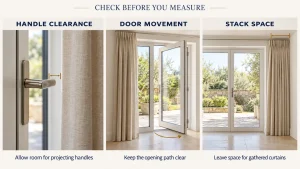
Anything that projects from the glass or wall, or that moves, limits where the curtain and its hardware can sit. Record each obstruction with its distance from the opening edge and how far it projects.
Window and door handles. A curtain fitted close to the glass can catch on a handle. Measure how far the handle projects from the glass or frame and where it sits. This affects how far the track must stand off the wall and whether the curtain can hang inside a recess.
Sliding and hinged doors. On a balcony or terrace door, the curtain must not block the door’s movement or its handle. Note which way the door opens or slides, and measure the handle position and any door track at floor level.
Items above and beside the window. Air conditioning units, curtain boxes, cornices, light switches, sockets and built in furniture can all limit the track position or the space beside the window. Measure their position relative to the opening and the proposed track.
Stack space. When a curtain is open, its fabric gathers into a stack at one or both ends of the track. If there is wall space beside the opening, the stack can sit there and leave the glass clear. If there is not, the open curtain will cover part of the window or door. The size of the stack depends on the fabric, the lining and the heading, so you cannot measure it in advance. What you can measure is the wall space available, which is what the installer needs to plan the stack. For wide windows and balcony doors, this is often the deciding constraint.
Which Measurements Does the Installer Need to Confirm?
The installer confirms every value that the curtain will be manufactured from. Your readings describe the window and your preferences; the final dimensions also depend on the heading, hardware and fixing position, which are confirmed during a site check.
| Value | What you provide | What the installer confirms |
| Track or pole span | Opening width, wall space and preferred span | Final hardware length and bracket positions |
| Mounting position | Your preference and the space available | Whether the wall or ceiling can take the fixing at that position |
| Drop | Measurement from your stated reference to your preferred finish | Manufacturing drop for the actual heading and hardware |
| Clearance | Handle, door and obstruction positions | How far the hardware stands off and where the curtain stacks |
| Level | Readings at several points | How uneven floors or ceilings are handled in the finished length |
| Fabric quantity | Your heading and fabric preference | The fabric width and fullness for that heading |
This division is why preliminary measurements are useful for a quote but should not be used to order fabric. If any reading changes after the site check, the quote changes with it.
Sending Your Measurements for a Quote
Send the measurements with photographs, because a photo often answers a question that a number cannot. Include a full view of each window with the tape measure visible, close ups of handles, door tracks and anything above the window, and the junction between the wall and ceiling if you want a ceiling fixed track.
Add the unit you used, the room each window is in, whether you want the curtain inside or outside the opening, and the finish you prefer at the hem. With that information, contact Jabal Al Riad to discuss the window and arrange for the measurements to be checked before the curtains are made.