Curtain installation follows a predictable sequence. The scope is agreed first, the room is prepared, and on the day the installer confirms the fixing positions with you, checks that the wall or ceiling can hold the hardware, fits the track or pole, then hangs and dresses the curtains. The work finishes with operation and coverage checks and a handover, where you are shown how the curtains work and how to look after them. How long it takes depends on the number of windows, the hardware, the fixing surface and whether the curtains are motorized, so treat any timing as specific to your job rather than a general rule.
If you are still choosing the curtains themselves, compare the curtain options first. Installation planning starts once the product, hardware and measurements are agreed.
What Should Be Prepared Before Curtain Fitting?
Prepare three things before the installer arrives: an agreed scope, a room the installer can work in safely, and surfaces that are finished and ready to take fixings. Most delays on fitting day come from one of these being unclear.
Use this checklist in the days before the appointment:
- Confirm the scope in writing. Check which windows are included, which hardware is being fitted and whether removing existing curtains or tracks is part of the job.
- Finish other work in the room. Painting, plastering, ceiling work and carpentry around the windows should be complete and dry, because hardware fixed before these trades finish may need to be removed again.
- Clear access to each window. Move furniture away from the wall and take fragile items, pictures and plants off sills and nearby surfaces so the installer can use a ladder safely.
- Tell the installer about hidden services. If you know of cables, pipes or air conditioning lines in the wall or ceiling near the window, say so before any drilling starts.
- Check building access. If your building has rules about contractor entry, working hours, lift use or parking, arrange them in advance.
- Prepare power for motorized curtains. If the curtains are motorized, the agreed power point and any wiring should be ready before fitting day, completed by a qualified person where electrical work is needed.
- Make sure someone can approve decisions. A person who can confirm positions, heights and any changes should be present, at least at the start and at handover.
What Does a Curtain Installation Scope Include?
A curtain installation scope lists exactly which work is included in the price. It is worth reading line by line, because items such as removing old hardware, filling old holes or electrical work are often treated as separate tasks rather than part of fitting.
The table below shows the items to confirm before the appointment. It does not describe any one supplier’s standard package; it shows what to ask so that your quote and the work on the day match.
| Scope item | Question to confirm | Why it matters |
|---|---|---|
| Fitting the new track or pole | Which hardware, how many windows, and at what mounting position? | The fixing position was planned from the measurements and should not change without agreement |
| Hanging and dressing the curtains | Are curtains hung, adjusted and their folds set on the day? | Dressing affects how evenly the curtain hangs and stacks |
| Removing existing curtains and hardware | Is removal included, and what happens to the old items? | Old brackets may sit where new ones need to go |
| Filling or repairing old fixing holes | Is making good included, or is that left for a painter? | Holes may remain visible after old hardware is removed |
| Ceiling or curtain box work | Does any concealed track or recess need preparation by another trade? | Some positions need joinery or ceiling work before the track can be fixed |
| Electrical work for motorized curtains | Who provides the power point and connection? | Electrical work may need a qualified electrician, separate from curtain fitting |
| Return visit for adjustment | If a curtain needs adjusting after it settles, how is that arranged? | Some fabrics and hems may need a later adjustment |
Why the fixing surface matters
The fixing surface decides how the hardware is attached. Concrete, blockwork, gypsum board ceilings, timber and curtain boxes all need different fixings, and some positions cannot hold a heavy curtain without additional support. The installer checks the actual surface at each fixing point before drilling. If the planned position turns out to be unsuitable, the right response is to stop and agree an alternative with you, not to fix the hardware anyway.
What Happens on Fitting Day?

On the day, the installation moves from confirming positions to fixing the hardware and then hanging the curtains. A typical sequence looks like this:
- Positions are confirmed with you. The installer reviews the agreed mounting height and span at each window and marks the bracket positions before drilling.
- Surfaces are protected. Floors and furniture near the window are covered where dust or debris could fall.
- The hardware is fixed and levelled. Brackets are fixed into the surface, and the track or pole is mounted and checked for level along its length.
- The curtains are hung. Gliders, hooks, rings or eyelets are attached according to the heading, and the curtain is hung on the hardware.
- The folds are dressed. The fabric is arranged so the folds are even when closed and gather neatly when open.
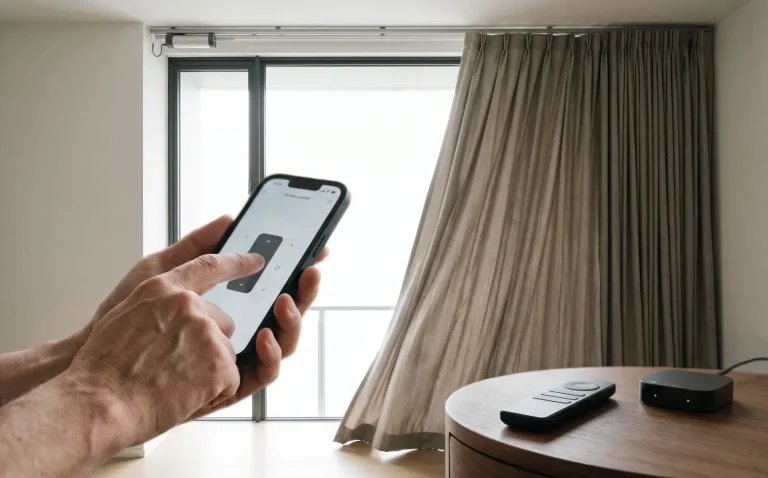
Motorized curtains add steps after the track is fixed: the motor is fitted, connected to the agreed power supply and configured for the intended controls.
How Are Operation and Coverage Checked?
The installation is checked by operating each curtain through its full travel and looking at how it covers the window when closed. These checks catch most problems while the installer is still on site, which is when they are easiest to fix.
Check the following before the installer leaves:
| Check | What a good result looks like |
|---|---|
| Full travel | The curtain opens and closes along the whole track or pole without sticking or jumping |
| Clearance | The curtain does not catch on window or door handles, sills or furniture as it moves |
| Closed coverage | The curtain covers the opening as agreed, with the panels meeting or overlapping in the centre |
| Hem level | The hem sits at the agreed finish, at a consistent height across the width |
| Open stack | When open, the fabric gathers where planned and does not block a door or handle |
| Separate layers | Where there are two curtains, each one opens and closes without disturbing the other |
| Motorized operation | The curtain stops at the correct open and closed positions, and each agreed control works |
If any check fails, ask for it to be corrected or recorded with an agreed next step before you sign off the job.
What Should Be Demonstrated at Handover?
At handover, you should be shown how each curtain operates, how to care for it, and what happens if something needs attention later. This is also the moment to confirm that the completed work matches the agreed scope.
Ask for the following at handover:
- Operation. A demonstration of opening and closing each curtain, including any wand, cord, remote, wall switch or app.
- Care instructions. The care information for the fabric and lining, and any instructions for the track or motor. Cleaning methods depend on the actual fabric, its lining and the mechanism, so keep the care labels and manuals rather than relying on general advice, and read how to clean curtains safely using those labels before the first wash or dusting.
- Outstanding items. A clear record of anything not finished or needing adjustment, with the agreed date or action.
- After sales terms. The warranty or service terms that apply to your installation, in writing, including what they cover.
- Product details. The fabric and hardware references, which make future replacements or additions easier to match.
Planning Ahead for Motorized Curtains
Motorized curtains need more planning before fitting day than manual ones. Decide where the power will come from and which controls you want, such as a remote, a wall switch or an app, before the installation date, because the power point and any concealed wiring have to be in place before the track is fitted. It also helps to plan the motor power and controls in detail before fitting day, covering whether the motor is mains or battery powered, which end of the track it sits at, and how the remote, wall switch or app will work with any smart home system. Then confirm which motor and controls are offered for your track, and who is responsible for the electrical connection.
Before You Book the Installation
A smooth installation depends on decisions made before the installer arrives: a written scope, finished surfaces, clear access and, for motorized curtains, power in the right place. When you are ready, contact Jabal Al Riad to discuss your curtain specification, confirm what the installation includes and arrange a suitable date.