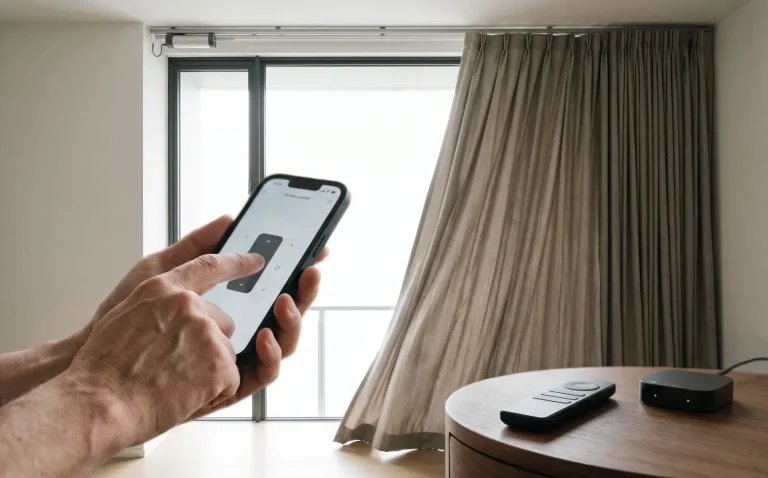
Wave and eyelet curtains differ in how the top of the curtain is built and what it hangs from. A wave curtain hangs from gliders in a matched track, and the track system fixes the spacing of every fold, so the curtain forms a regular, continuous wave whether it is open or closed. An eyelet curtain has metal or plastic rings set into the fabric and threads directly onto a pole, so its folds come from the eyelet spacing and from how the fabric is pushed along. In practice, choose wave when you want an even, controlled fold and the flexibility of a track, including ceiling fixing and, where the system supports it, motorization. Choose eyelet when you want a pole as a visible feature and a simple, manually drawn curtain. Neither heading decides how much light the curtain blocks; that depends on the fabric, the lining and how the curtain is fitted.
How Do Wave and Eyelet Headings Form Their Folds?
The folds of a wave curtain are set by the hardware; the folds of an eyelet curtain are set by the fabric. That single difference explains most of what you see at the window.
A wave curtain has a heading tape that attaches to gliders running in the track. The gliders are linked at fixed intervals, so when the curtain is closed the fabric can only extend so far between each pair. The result is a smooth, repeating S shaped fold that sits in front of and behind the track line in equal measure, and it stays that way every time the curtain is drawn. Because the fold depends on the glider spacing, the wave curtain tape, the gliders and the track all have to belong to the same system.
An eyelet curtain has rings pressed into the top of the fabric at regular intervals, and the pole passes through them. The spacing between the eyelets creates the folds, and an even number of eyelets lets both edges of the curtain turn back towards the wall. Nothing links the eyelets together, so the folds depend on the fabric and on how the curtain is pulled. A stiffer heading and a fabric with some body hold the fold shape better than a very soft one.
| Feature | Wave heading | Eyelet heading |
|---|---|---|
| What forms the fold | Fixed glider spacing in the track | Eyelet spacing in the fabric |
| Fold when closed | Regular and repeated across the width | Deep folds whose regularity depends on the fabric and how it is drawn |
| Top of the curtain | Hangs below the track | Rises above the pole between the eyelets |
| Visible hardware | The track can be concealed or fixed to the ceiling | The pole and its finials are part of the look |
| Fabric choice | Must suit the wave system’s tape and glider spacing | Must take eyelets and be heavy enough to hold its folds |
Which Track or Pole Does Each Heading Need?
A wave curtain needs a track and gliders designed for wave headings, while an eyelet curtain needs a pole whose diameter fits through the eyelets with room to slide. Neither heading can simply be moved onto the other’s hardware.
Wave hardware. The track, gliders and tape are matched, and different systems use different glider spacings, which change the depth of the wave. An existing track may not be reusable if it was not designed for wave gliders. Wave tracks can be fixed to the wall or the ceiling, and a ceiling fixed track can sit inside a recess or a curtain box, which is useful where there is no wall space above the window.
Eyelet hardware. The pole runs through the eyelets, so the eyelet’s inside diameter must clear the pole comfortably or the curtain will drag. Poles are normally fixed to the wall on brackets, and the brackets set how far the curtain hangs from the wall. On a long pole, a central support bracket blocks the eyelets from passing, so each curtain stays on one side of it.
Operation. Both headings can be drawn by hand. Wave curtains run on gliders in a track, and some wave track systems are available with motors. An eyelet curtain slides on its rings along the pole, and motorizing it needs a system designed for that purpose, so do not assume a motor can be added to an ordinary eyelet pole.
Before you decide, check which tracks and poles are offered for the heading you prefer and whether your existing hardware can stay. The available curtain tracks and accessories are the place to start that comparison.
How Do Drop References and Open Stack Differ?

The two headings start their drop from different points and gather differently when open, so the same window can need different measurements for each.
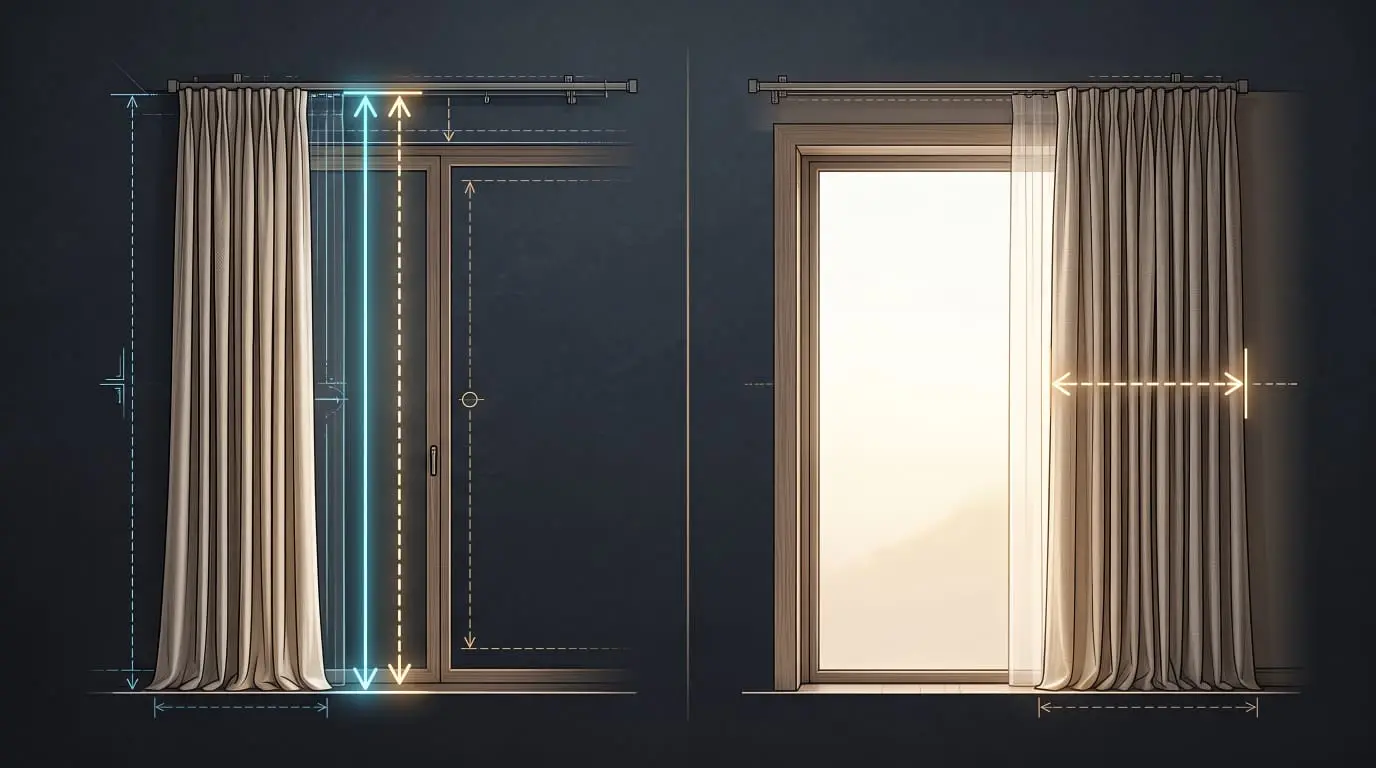
Drop reference. A wave curtain hangs below its gliders, so its drop is measured from the track or glider point defined by that system. An eyelet curtain rises above the pole between the eyelets, so its drop is usually taken from the top of the pole. Using the wrong reference is one of the easiest ways to end up with a curtain that is too long or too short, which is why it helps to prepare curtain measurements with the heading already chosen.
Open stack. Both curtains gather at the ends of the track or pole when open. A wave curtain gathers into a uniform stack because its folds are fixed. An eyelet curtain’s stack depends on the fabric and on how tightly it is pushed back. The width and depth of either stack depend on the fabric, the lining and the amount of fabric across the window, so compare the actual curtains rather than relying on a general rule.
Top coverage. Because an eyelet curtain sits on a pole below the ceiling or wall line, some light can pass above it. A ceiling fixed wave track can close that gap. This is a fitting difference, not a property of the fabric, and it matters most where the room needs to be dark.
Which Heading Suits Your Window?
Whether wave curtains or eyelet curtains suit your window depends on the opening and how you will use the curtain, not on the heading’s name. Use this table to match your priorities to the heading that suits them, then check that the actual system fits your opening.
| Your priority | Heading that usually suits it | What to check |
|---|---|---|
| Even, regular folds across the window | Wave | That the fabric is suitable for the chosen wave system |
| A decorative pole as part of the design | Eyelet | Pole diameter, finish and finials against the eyelet size |
| No wall space above the window, or a ceiling recess | Wave | Ceiling fixing position and depth of the recess |
| Motorized operation | Wave, on a motor compatible track | That the motor and track are offered together for your window |
| Simple manual operation on a pole | Eyelet | Pole length and whether a central bracket splits the curtain |
| Light blocked above the curtain | Wave on a ceiling fixed track | Coverage at the top and sides, plus the fabric and lining |
| Two layers on one window | Either, on separate tracks or poles | Space for both sets of hardware and both open stacks |
If your priorities point to a pole based design, review the eyelet curtains and ask to see the fabric hanging on the intended pole, because eyelet folds vary more with the fabric than wave folds do.
Choosing Between Wave and Eyelet
Wave curtains give a controlled, regular fold and more freedom in how the hardware is fixed. Eyelet curtains give a simpler, pole based look with folds that depend on the fabric. The fabric, lining and fitting still decide how much light and privacy either one provides.
When you have a preference, contact Jabal Al Riad with photographs of the window, the heading you are considering and whether you want a track or a pole. Ask to see the chosen fabric made up in that heading and to confirm which hardware suits your opening before the curtains are measured and made.