Choose curtain fabric by looking at the actual sample, not the name of the material. Five things decide whether a fabric will work at your window: what the label says it is made of, how the weave behaves against the light, how the fabric drapes once it is lined and made up, whether it suits the heading and hardware you want, and how the face fabric and lining can be cleaned together. Names such as linen, velvet or polyester describe a family of fabrics, and two fabrics with the same name can behave very differently. Whether you are considering “sheer curtains” or a heavier lined curtain, ask for a sample you can hold up at your own window before you decide.
What Should a Curtain Fabric Label Tell You?
The label or supplier datasheet is the only reliable record of what a fabric is. It should tell you the fibre composition, usually as percentages, along with the care instructions. Ask for it with every sample you are seriously considering.
Composition matters because it affects how the fabric responds to sunlight, washing and humidity. A fabric sold as “linen look” may contain little or no linen, and a blend behaves partly like each of its fibres. Do not assume a fabric is washable, fade resistant, flame retardant or UV protective because of its name or appearance. If any of those properties matter to you, ask for the document that states it for that exact fabric.
| Information to ask for | Why it matters |
|---|---|
| Fibre composition, with percentages | Indicates how the fabric may respond to sun, washing and shrinkage |
| Fabric width | Affects how many widths are joined across a wide window |
| Fabric weight, often given in grams per square metre | Gives an early idea of drape and how much load the finished curtain adds |
| Care symbols | Show the maximum cleaning treatment the fabric can take |
| Any test or performance documents | The only basis for claims about fire, light fastness or UV behaviour |
How Does the Weave Affect Light and Drape?
The weave decides how much light passes through the fabric and how it hangs. An open or fine weave lets light through and gives a soft, airy drape; a dense weave holds back more light and hangs with more body.
Judge this at the window, not in a showroom. Hold the sample against the glass at the time of day the room is used most, and look at it from inside the room. A pale fabric that looks solid on a table can glow and show its weave when the sun is behind it. A dark fabric of the same weave will usually let less light through but can look heavier in a small room. If you are still deciding between filtered daylight and a darkened room, compare sheer and blackout functions before you narrow down the fabric, because that choice determines whether the face fabric alone does the job or needs a lining.
Drape is easiest to judge by gathering the sample in your hand and letting it fall. A fabric that falls in soft, even folds will usually make up well into full curtains. A stiff fabric holds crisp folds but can stand away from the window, and a very limp one may cling or twist.
Curtain fabric for a sunny room
In a room with strong direct sun, fading and fibre breakdown become part of the choice. Sunlight affects both the dye and the fibre. A university extension bulletin on home fabrics rates acrylic and polyester as holding up well in sunlight, while cotton gradually loses strength and yellows, rayon is affected more than cotton, and silk depends on its dye and finish. Those are general fibre tendencies, not a guarantee for any particular fabric, and dye quality matters as much as fibre. For a sunny window, ask whether the fabric has been tested for light fastness, and consider a lining, which keeps direct sun off the back of the face fabric.
How Do Weight and Lining Change the Finished Curtain?
Weight and lining change three things: how the curtain hangs, how much light it holds back, and how much load the track or pole has to carry. They should be judged together, because the lined curtain is what will hang at the window.
A lining is a second fabric sewn behind the face fabric. A standard lining adds body and protects the face fabric from direct sun. A blackout lining holds back light that the face fabric would otherwise let through. Either one changes the drape, usually making folds fuller and heavier, so ask to see the face fabric with its intended lining rather than on its own. If darkness is the priority, the lining or a dense “blackout curtain” fabric does most of that work, not the colour of the face fabric.
The finished weight depends on the fabric weight, the lining, the drop and the amount of fabric gathered across the window. A long, wide, lined curtain can be much heavier than the same fabric unlined. That combined weight is what the installer checks against the capacity of the track or pole and its fixings, so share your fabric and lining choice before the hardware is confirmed.
Does the Fabric Suit the Heading and Hardware?

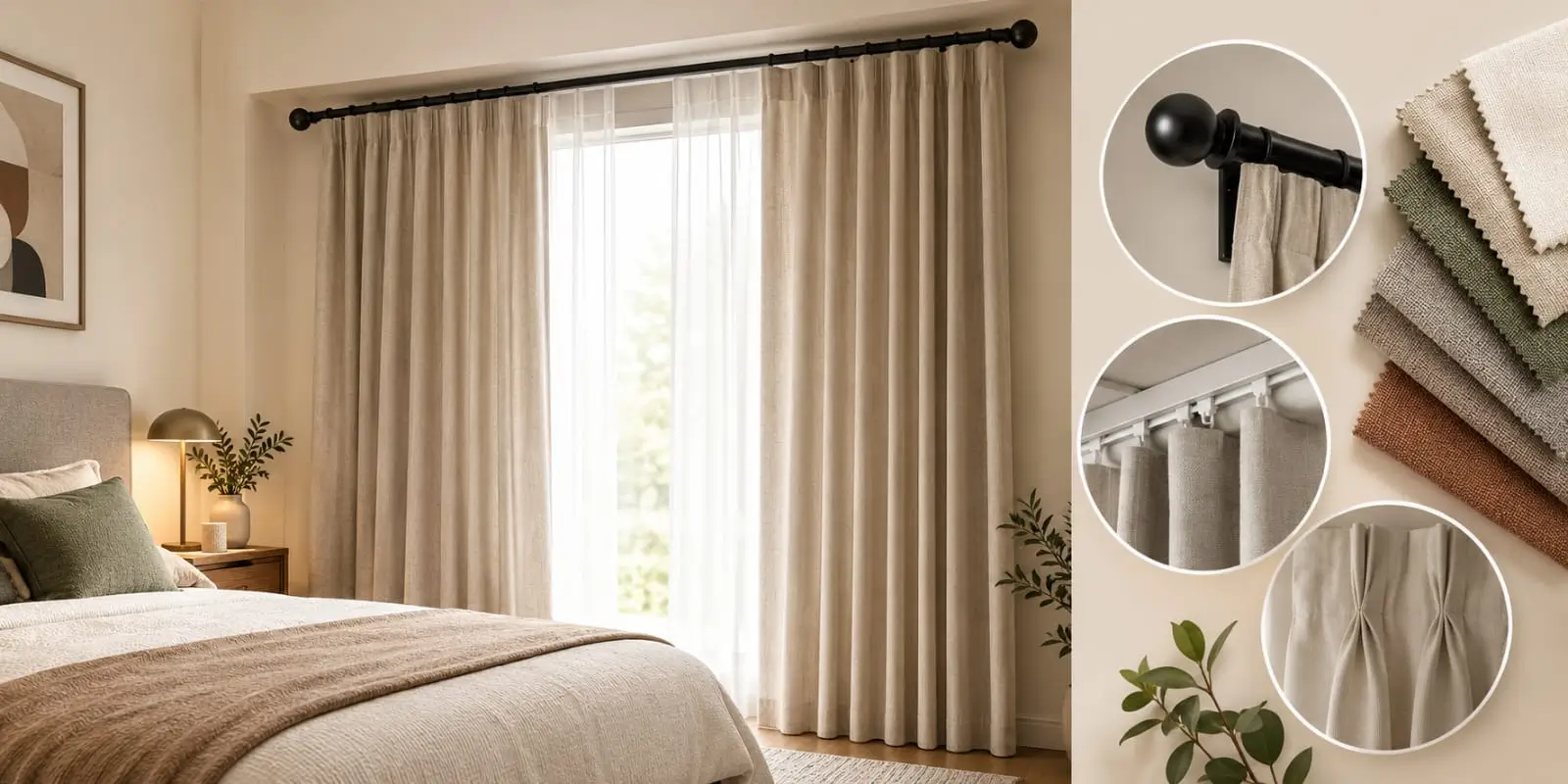
A fabric has to suit the heading it will be made into. Some fabrics hold a particular fold shape well and others do not, and each heading places its own demands on the material.
A wave curtain relies on the fabric to form and hold a smooth, regular wave between the gliders, so the fabric needs enough body and the right weight for the chosen wave system. An eyelet curtain needs a fabric that can take the eyelets without puckering and has enough weight to hang in folds below the pole. A very lightweight sheer can move freely on a track but may not hold an eyelet heading neatly.
Heavy, lined fabric also needs hardware rated for it. Ask whether the fabric you like is suitable for the heading you prefer, and whether the track or pole that goes with that heading can carry the finished curtain.
Which Care Instructions Apply to the Fabric and Lining Together?
The care method for a curtain has to suit both the face fabric and the lining. Where the two labels differ, the more restrictive instruction applies to the finished curtain.
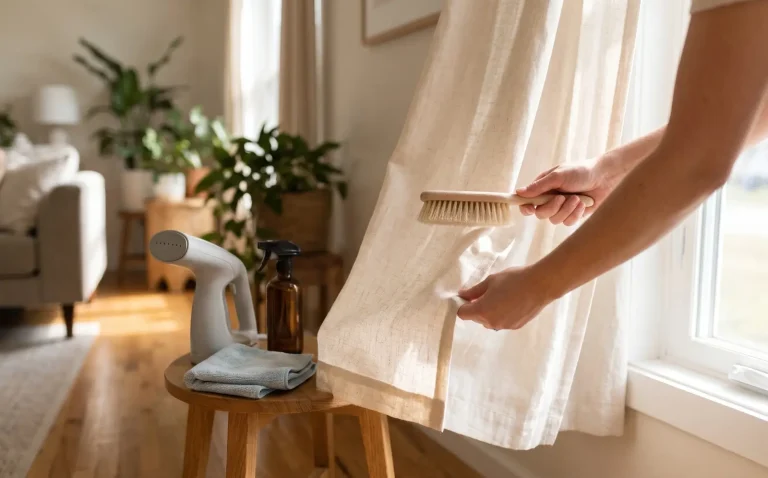
Care symbols follow the international ISO 3758 care labelling code, which shows the maximum treatment a textile can take for washing, bleaching, drying, ironing and professional cleaning. Check both labels before you choose. A face fabric that can be washed may be sewn to a lining that cannot, and fabrics with different fibres can shrink by different amounts, which can distort a lined curtain if it is washed. If easy cleaning matters to you, include it as a selection criterion now rather than discovering the limits after the curtains are made. Once the curtains are hanging, keep both care labels and follow the approved curtain care method for that face fabric and lining, so dusting, spot cleaning and any washing or dry cleaning stay within what both layers can take.
A Simple Way to Assess a Curtain Fabric Sample
Use these steps to evaluate curtain fabric samples at home before you commit:
- Read the label. Note the composition, width, weight and care symbols, and ask for any test documents behind performance claims.
- Test it against the light. Hold the sample at the window at the time of day the room is used and look from inside.
- Check the drape. Gather it in your hand and let it fall, ideally with the intended lining behind it.
- Match it to the heading. Confirm that the fabric suits the wave, eyelet or other heading you want.
- Compare the care labels. Make sure the face fabric and lining can be cleaned the same way.
- Think about the sun. For a bright window, ask about light fastness and whether a lining is recommended.
When you have two or three samples that pass these checks, contact Jabal Al Riad with photographs of the window and the samples you prefer. Ask to see each fabric with its intended lining and heading, and confirm the composition and care instructions for the exact fabrics before the curtains are made.