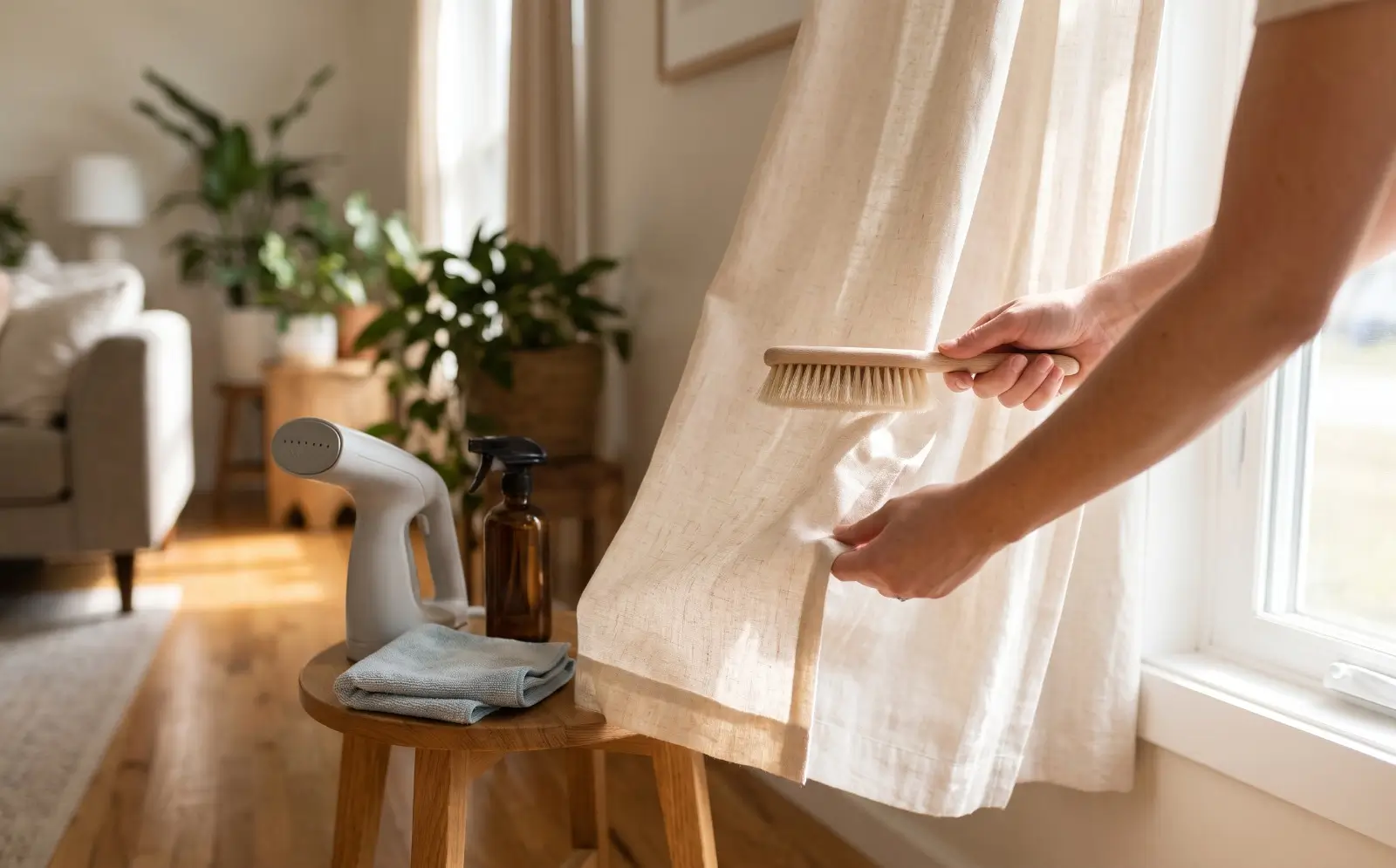
To clean curtains safely, start with the care label on the face fabric and the lining, not with a general cleaning tip. The label shows how the fabric may be washed, dried, ironed or professionally cleaned, and where the face fabric and lining differ, the stricter instruction applies to the whole curtain. Between cleans, regular dusting does most of the work and reduces how often a full clean is needed. The track, pole or motor has its own care needs, set by the manufacturer of that model. If a curtain has no label, or the label and the fabric seem to disagree, ask the supplier before washing it, because water, heat and cleaning products can shrink, distort or mark some curtain fabrics.
What Does a Curtain Care Label Tell You?
The care label tells you which cleaning methods the fabric can take. It is the starting point for every cleaning decision, and it overrides general advice about curtains of the same type.
Care labels use a set of symbols defined in the ISO 3758 care labelling standard. They cover five kinds of treatment:
| Symbol group | What it tells you |
|---|---|
| Washing (a tub) | Whether the fabric can be washed in water, and at what maximum temperature or by hand |
| Bleaching (a triangle) | Whether any bleach can be used, and which kind |
| Drying (a square) | Whether tumble drying is allowed, or the fabric should be dried flat or hung |
| Ironing (an iron) | Whether the fabric can be ironed, and how hot |
| Professional care (a circle) | Whether it should be dry cleaned or professionally wet cleaned |
A cross through a symbol means that treatment should not be used. Read every group, not just the washing symbol. A curtain that can be washed may still be damaged by tumble drying or a hot iron.
Keep the labels, or a photograph of them, when the curtains are made. Labels are often sewn into a hem or side seam, and they are much harder to find once the curtains are hanging.
Why Does the Lining Change How a Curtain Can Be Cleaned?
A lined curtain is two fabrics sewn together, so it can only be cleaned in a way that both fabrics tolerate. If the face fabric can be washed but the lining should only be dry cleaned, the curtain as a whole should be treated as dry clean only.
Two problems arise when the two layers are treated differently:
- Uneven shrinkage. Different fibres can shrink by different amounts when washed. If the face fabric and lining shrink unevenly, the curtain can pucker, pull at the seams or hang crooked.
- Damaged coatings. Some blackout linings and fabrics have a coated backing that blocks light. Coatings can be damaged by washing, tumble drying or ironing if those treatments are not permitted on the label, which can leave cracks that let light through.
This is the heart of good blackout curtain care: check whether the blackout effect comes from a coating, a separate lining or the weave of the fabric, and follow the label for that construction. If you are choosing new blackout curtains, ask how the fabric and lining should be cleaned before you buy, so the care routine suits how you live.
How Should You Care for Curtains Between Cleans?
Regular light care keeps curtains clean for longer and reduces the number of full cleans. Dust is the main thing to manage, along with the effects of strong sun.
- Dust regularly. Use a vacuum cleaner with a soft brush attachment on a low setting, working from the top of the curtain downwards, or gently shake curtains that are easy to reach. Pay attention to the folds and the top of the heading, where dust settles.
- Deal with marks carefully. If you need to treat a small mark, check the label first and test any treatment on a hidden part of the curtain. Blot rather than rub, because rubbing can spread a mark or roughen the surface of the fabric.
- Handle sheers gently. Fine sheer curtains can snag or pull on jewellery, hooks and rough hands. Lift them rather than drag them when you open or move them.
- Watch for sun damage. Curtains in direct sun can fade or weaken over time, especially along the leading edges that stay in the light. Opening and closing them so different parts take the sun, and keeping a lining behind the face fabric, both help.
How Do You Look After Curtain Tracks, Poles and Motors?

Curtain track maintenance depends on the exact track, pole or motor, so follow the manufacturer’s instructions for your model. In general, the aim is to keep the hardware clean and free running without adding anything the manufacturer does not permit.
- Keep the track clean. Dust and grit in a track can make gliders run less smoothly. A dry cloth or soft brush is usually enough. Check the manual before using any spray or lubricant, because some tracks and gliders are designed to run without one.
- Check poles and rings. On an eyelet or ring curtain, wipe the pole so the rings or eyelets slide freely, and avoid products that leave a residue on the finish.
- Leave motors to the manual. For a motorized curtain, follow the motor manufacturer’s guidance on cleaning around the motor and track. Do not open the motor housing or clean near electrical parts unless the manual allows it, and switch off or disconnect power where the manual says to.
- Notice changes early. If a curtain starts to stick, drag or stop at the wrong position, check for a dislodged glider or an obstruction before forcing it, and ask the installer if the problem continues.
What Should You Know Before Taking Curtains Down to Clean Them?
Taking a curtain down is the riskiest part of cleaning it, because the heading and hardware have to go back exactly as they were. Plan the removal before you start.
Note how the curtain attaches: hooks, gliders, rings or eyelets. On a wave curtain, the heading attaches to gliders at fixed spacing, and the fold depends on rehanging it in the same positions. Photograph the heading and the hardware before removing anything, and keep hooks or gliders together in a bag so none go missing.
If the label calls for professional cleaning, or the curtains are large, heavy or lined, a specialist curtain cleaner may be the safer choice. Tell the cleaner what the face fabric and lining are made of and show them both labels.
Which Care Instructions Should You Ask For?
Ask for the care information when the curtains are made, not years later when they need cleaning. Keep it with your home documents.
- The care label or supplier instructions for the face fabric
- The care label for the lining, if the curtain is lined
- Any cleaning restrictions for coated blackout fabrics or linings
- The manual for the track, pole or motor, including any cleaning and maintenance guidance
- The fabric and hardware references, so replacements can be matched later
If you need any of this information for curtains supplied by Jabal Al Riad, contact Jabal Al Riad with photographs of the curtains and any labels you can find, and ask for the care instructions that apply to your fabric, lining and hardware.