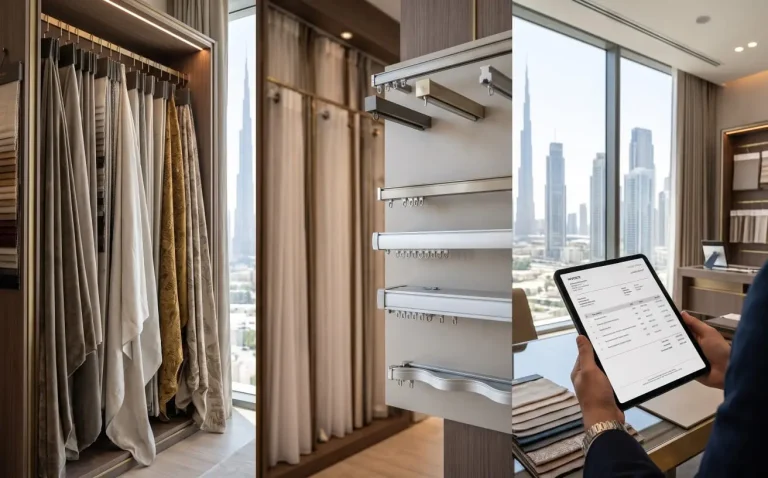
Curtains for wide windows and balcony doors have to work in two positions. Closed, they need to cover the whole opening. Open, the gathered fabric has to go somewhere, and on a wide opening that gathered stack is large enough to block glass, narrow a doorway or catch on a handle. Plan three things before choosing the curtain: which way the curtain will draw and where it will stack, how much wall space there is beside the opening for that stack, and how the door or window moves. The stack size depends on the heading, fabric, lining and amount of fabric, so it has to be estimated for your actual curtain rather than taken from a general rule.
How Do Opening Width and Door Movement Affect Curtain Placement?
The way a door or window opens decides where the curtain must not be. A curtain that blocks a sliding panel or sits in front of the handle you use every day will be pushed aside every time the door is used.
Start with the movement of the opening itself:
- Sliding doors. Note which panel slides and in which direction, and where its handle sits. The curtain should stack clear of the panel you use, so you can open the door fully without moving fabric out of the way.
- Hinged doors and windows. If a door or window opens into the room, the curtain must stack beyond the full sweep of the door, not just beside the frame.
- Handles and locks. Measure how far handles project from the glass. They affect how far the track must stand off the wall and whether a curtain will drag over them.
Then decide how the curtain draws. This choice controls where the fabric ends up when open.
| Draw option | Where the fabric stacks | When it suits a wide opening |
|---|---|---|
| Centre split, two panels | Half the fabric at each end of the track | When there is wall space on both sides of the opening |
| One way draw, single panel | All the fabric at one end | When one side is blocked by a corner or wall, or when the door you use is at the other end |
| Several panels on one long track | At the ends and at agreed points along the track | On very wide glazing where one or two stacks would be too large, with the stacks placed over the fixed panels |
On a balcony door, a one way draw towards the fixed panel often keeps the sliding side completely clear. On a long window wall with a door in the middle, stacking at the fixed sections either side of the door can keep the doorway free.
How Much Stack Space Do You Need?
Curtain stack space is the room the open curtain occupies beside the opening, and you need enough of it on the wall if you want the full glass clear. How much that is depends on the curtain, so the answer comes from your actual specification, not from a percentage of the window width.
Four things change the size of a stack:
- Heading. Headings gather the fabric in different ways. A wave curtain gathers into a uniform stack set by its track system, while other headings depend more on the fabric and how it is pushed back.
- Fabric thickness. A thick or textured fabric stacks wider and deeper than a fine one.
- Lining. A lined curtain has two layers of fabric in every fold, so it stacks larger than the same fabric unlined.
- Amount of fabric. A wider opening means more fabric across the track, and more fabric means a larger stack.
The practical method is to ask for the estimated stack width of the curtain you are considering, then compare it with the wall space you have on each side. If the stack fits on the wall, the glass stays clear. If it does not, part of the opening will be covered even when the curtain is open, and you can decide whether that is acceptable or change the specification.
How Do Track Extensions, Returns and Layers Affect the Usable Opening?
The usable opening is the part of the window or door that is actually clear when the curtain is open. Three choices change it: how far the track extends, whether the curtain returns to the wall at the ends, and whether there is more than one layer.
Extending the track. A track that runs past the opening on each side lets the stack sit on the wall instead of over the glass. The extension is limited by corners, adjacent walls, built in furniture and air conditioning units, so measure what is actually available on each side.
Returns at the ends. A return brings the end of the curtain back to the wall, closing the gap at the side where light and views slip past. It improves coverage but sits at the ends of the track, exactly where the stack also needs to go, so allow for both.
Two layers. A sheer and a blackout curtain on separate tracks produce two stacks at each end, one in front of the other. Together they are deeper and can be wider than a single stack, and the second track also adds depth in front of the glass and the door handle. On a balcony door with little wall space, that combined stack can decide whether the sliding panel stays clear. Before you commit to layering a wide opening, check the two layer track arrangement so the track spacing, both open stacks and the handle clearance are planned together.
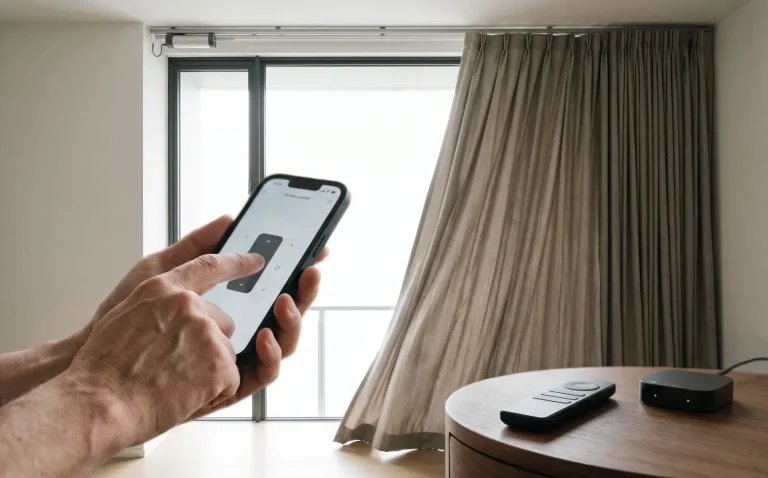
Motorized tracks. Some motorized systems need space at the end of the track for the motor unit, and the curtain cannot stack where the motor sits. If you are considering motorized curtains for a wide opening, ask where the motor will be placed and how that affects the open stack.
An Example of Planning a Wide Balcony Door
The figures below are illustrative, not recommendations. They show how the opening, the wall space and an estimated stack combine.
A living room has a sliding balcony door 300 cm wide. The left 150 cm panel slides; the right panel is fixed. There is 40 cm of wall to the left of the door and a corner 5 cm to the right. Suppose the installer estimates that the chosen lined fabric, with its heading, stacks to about 60 cm in total.
| Option | What happens when open |
|---|---|
| Centre split, half the stack each side | The right half stacks over the fixed glass because there is no wall space; the left half fits on the wall. The sliding panel is clear. |
| One way draw to the left | The full stack is wider than the 40 cm of wall, so part of it covers the left edge of the sliding panel. |
| One way draw to the right | The whole stack sits over the fixed panel and the sliding panel stays fully clear. |
In this example, two options keep the sliding panel fully clear. The centre split covers less of the fixed glass, because only half the stack sits over it. The one way draw to the right keeps all the fabric in one place but covers more of the fixed panel. Drawing to the left is the only option that obstructs the door. A different fabric, heading or track position would change the result, which is why the stack estimate should come from your actual curtain.
What Should You Record Before the Survey?
Record the opening’s movement and the space around it, not just its width and height. These readings let the installer plan the draw direction, track length and stack position on the first visit.
- Total opening width and height, and the width of each panel
- Which panels slide or open, in which direction, and where each handle sits
- How far handles project from the glass or frame
- Wall space on each side, up to the nearest corner, cabinet or other obstruction
- Anything above the opening that limits the track, such as a curtain box, ceiling recess or air conditioning unit
- Whether you want one layer or two, and whether you are considering motorized operation
- Photographs of the whole opening and close ups of handles and corners
For the full set of width, drop and obstruction readings, follow the steps to prepare curtain measurements and record them alongside these clearance notes.
Planning Curtains Around Your Opening
On a wide window or balcony door, the open curtain matters as much as the closed one. Decide which way the curtain should draw, check the wall space against the stack your chosen curtain will make, and keep the panel you use every day clear.
When you have your notes and photographs, contact Jabal Al Riad to discuss the opening and ask for the stack and draw direction to be planned for the curtain you have in mind before it is made.