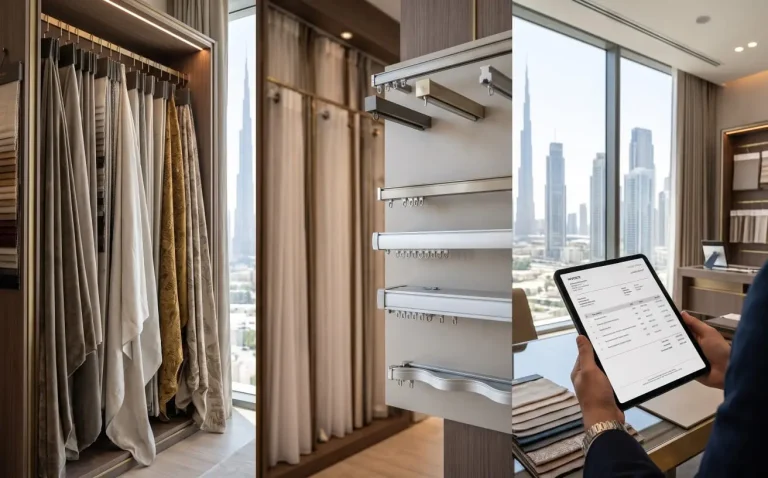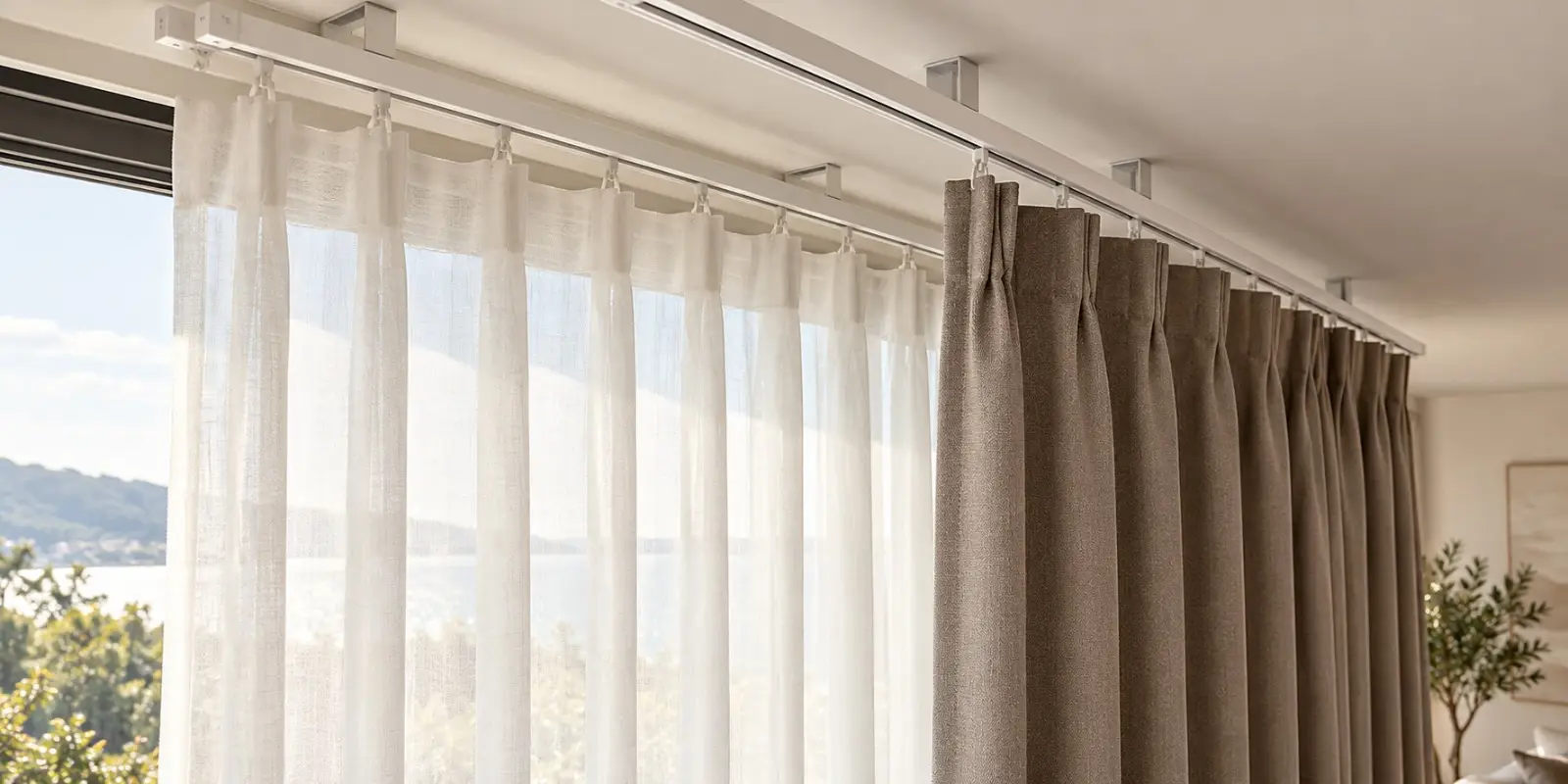
To layer sheer and blackout curtains, hang each curtain on its own track so the two can open and close independently. The usual arrangement puts the sheer on the track nearest the glass and the blackout curtain on the track facing the room. Before anything is ordered, check three things against the actual window: that there is enough depth for both tracks and both sets of folds, that the rear curtain will clear the window or door handles, and that there is room beside the opening for two stacks of fabric when both curtains are drawn back. An installer should confirm the spacing and hardware for your window, because a layout that works on paper can still fail on a narrow recess or a projecting handle.
Your choice of hardware decides most of this, so it helps to look at the available curtain tracks and accessories early and ask which arrangement suits two layers on your window.
When Are Two Curtain Layers Useful?
Two layers make sense when one window needs different things at different times of day. A sheer gives filtered daylight and some screening while the room is in use. A blackout curtain gives darkness and full privacy when it is closed. With both on separate tracks, you can close only the sheer during the day, close the blackout at night, or open both for a clear view.
| What you want from the window | Layer that does it |
|---|---|
| Soft daylight with the view from outside blurred | Sheer closed, blackout open |
| Darkness for sleep, or privacy with the lights on | Blackout closed |
| A clear view and full daylight | Both open |
| Night privacy with the sheer already drawn for the morning | Both closed |
If the room only ever needs one of these functions, a single curtain is simpler and needs less space. Two layers earn their place when you would otherwise have to choose between a bright room and a private one. Each layer should be chosen for the job it does: the sheer for filtered daylight and daytime screening, the blackout curtain for room darkening and privacy after dark, when a lit room shows through a sheer. If you are not yet sure which of these matters most in your room, compare light and privacy functions of sheer and blackout curtains before you plan the tracks.
Which Layer Should Go Closest to the Window?
In most layered windows the sheer hangs on the rear track, nearest the glass, and the blackout curtain hangs on the front track, facing the room. A lightweight sheer curtain suits the rear position because it stays drawn across the glass for most of the day and filters the light before it reaches the front layer. This order matches how the layers are usually used: the sheer stays closed for long periods of the day, and the blackout curtain is drawn across in front of it in the evening. The blackout curtain also becomes the main decorative fabric when it is open and stacked at the sides.
The reverse order is possible, with the blackout curtain behind and the sheer facing the room. People choose it when they want the sheer to be the visible face of the window at all times. The practical drawback is operation: to close a rear curtain by hand you have to reach behind the front one, so this layout usually works better with wands or motorized tracks.
Whichever order you choose, decide it before the brackets are fixed. Swapping the layers later means moving the curtains between tracks, and if the two layers have different headings or weights, the tracks may not be interchangeable.
What Does an Independent Two Track Arrangement Need?

An independent arrangement needs two tracks, brackets that hold them at a fixed distance apart, a surface that can take the combined weight, and a heading and operating method for each layer. Each of these is chosen for the actual curtains rather than assumed.
Two tracks, or one double system. The layers can run on two separate tracks fixed one in front of the other, or on a double curtain track or double bracket that carries both. Either way, each layer needs its own channel so it moves without dragging the other.
Spacing between the tracks. The front curtain must hang clear of the rear curtain’s folds. Deeper folds, such as those of a wave heading, need more space between the tracks than a flat sheer. The bracket or track system sets this spacing, so it should be confirmed for the headings you have chosen rather than guessed.
Mounting surface. Two tracks can be fixed to the ceiling or to the wall above the window. Ceiling fixing holds both tracks directly above the opening, while wall fixing needs brackets deep enough to hold both tracks and their curtains clear of the wall. The installer checks that the ceiling or wall can carry the hardware and both curtains at the chosen positions.
Weight of each layer. A lined blackout curtain is usually heavier than a sheer, because its dense fabric or blackout lining adds weight to the front track. Each track must suit the weight of the curtain it carries, and on a wall fixed double bracket the brackets carry both loads at once.
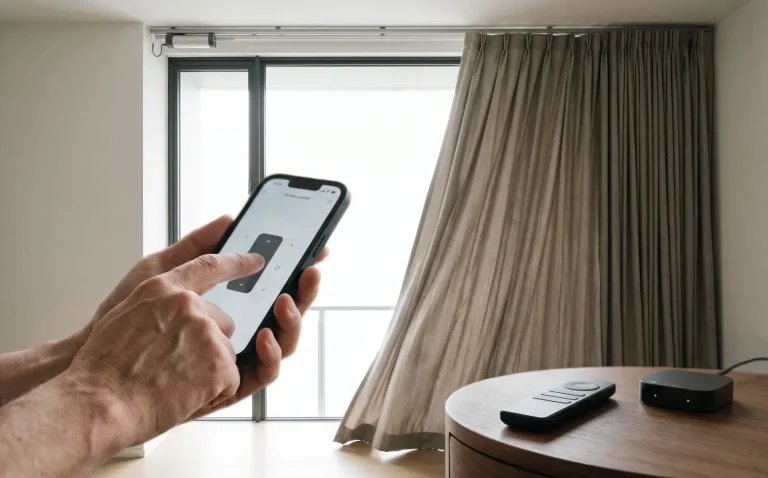
Heading and operation for each layer. The two layers do not have to share a heading, but each heading must suit its own track. If you want motorized operation, decide which layers will be motorized and confirm that the motor and track are offered together for your configuration. Do not assume that a motor for one track type will fit the other.
How Is Clearance Checked in the Open and Closed Positions?
Clearance is checked twice: with both curtains closed, to make sure the layers do not interfere with each other or the window, and with both open, to make sure the gathered fabric does not block the glass or a door. Two layers take up more room in both positions than one.
| Position | What to check | Why it matters with two layers |
|---|---|---|
| Closed | The rear curtain hangs clear of window and door handles | The rear layer sits closest to the glass and is the one most likely to catch |
| Closed | The front curtain hangs free of the rear curtain | If the tracks are too close, the front layer pushes the rear folds out of shape |
| Closed | Both layers meet or overlap in the centre and reach the edges of the opening | A gap in the blackout layer lets light past even when the sheer is closed |
| Open | Both stacks fit in the wall space beside the opening | The two stacks sit one in front of the other, so together they are deeper and can be wider than a single curtain’s stack |
| Open | The stacks leave a door or balcony opening usable | Thick stacks can narrow a door opening or sit in the path of a sliding door |
| Inside a recess | The recess is deep enough for both tracks, both sets of folds and the handle | Two layers often need the tracks outside the recess or on the ceiling instead |
When wall space beside the opening is tight, the open stacks may have to sit partly over the glass. That is a trade off to accept or design around before ordering, not something to discover on fitting day. On wide windows and sliding balcony doors this question often decides the whole layout, because the two stacks, the draw direction and the door’s movement all compete for the same space, so it pays to plan open curtain clearance around the opening before the track length is fixed.
How Should Each Layer Operate and Be Handed Over?
Each layer should open and close through its full travel without moving the other. Test them one at a time, then together, before the installer leaves.
Check the following at handover:
- Independent movement. Draw the sheer across while the blackout curtain stays open, then the reverse. Neither layer should snag, drag or lift the other.
- Full travel on both tracks. Each curtain should reach both ends of its track smoothly and stop where it should.
- Reach for manual operation. If the rear layer is operated by hand, make sure you can reach it comfortably through or past the front layer, or that a wand is fitted.
- Controls for motorized layers. Confirm which remote button, wall switch or app setting operates which layer, and that each stops at the correct open and closed positions.
- Care for each fabric. A sheer and a lined blackout curtain often have different care instructions. Keep the instructions for each layer separately.
Planning Your Layered Window
A layered window is a small specification: two fabrics, two tracks, a fixed spacing and a plan for where each curtain sits when open. Getting it right depends on the depth around the window, the handles, the wall space beside the opening and the weight of the curtains.
Before you ask for a quote, note which layer you want in front, how each layer will be operated, and the measurements of the opening and the wall space on each side. Take photographs that show any handles and the junction between wall and ceiling. Then contact Jabal Al Riad to discuss the window and confirm a two layer arrangement that suits it.